Ramírez argues that no oil-producing country would accept foreign control of its reserves, comparing the situation to Iraq's post-invasion oil revenue management.
He claims that during his tenure, PDVSA produced 3 million barrels per day until 2013, but production collapsed to 770,000 by 2019 due to Maduro's mismanagement and sanctions.
Ramírez denies responsibility for PDVSA's debt and corruption allegations, attributing them to political persecution by Maduro's government.
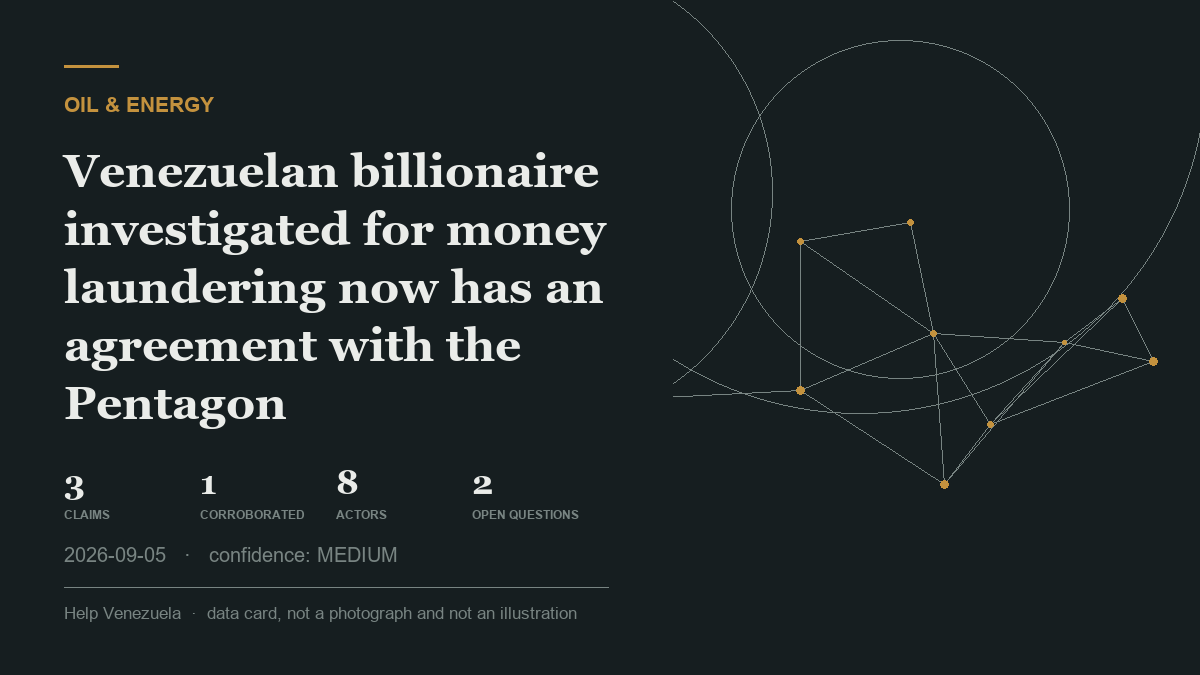
He questions the credibility of the U.S. investment deal with NABEP, noting Alejandro Betancourt has no oil industry experience.
Source ecology
BBC Mundo · intl wire · reliability A
Centrist; UK public broadcaster editorial standards — BBC (UK public broadcaster)
- Occasional both-sides framing can flatten authoritarian asymmetry
Rafael Ramírez's interview with BBC Mundo constitutes a significant signal from a high-level former insider, but its epistemic status is mixed. His assertion that no oil-producing country would accept foreign control of its reserves, comparing to Iraq, is an opinion with only one piece of corroborating evidence, and thus should be treated as an interpretive claim rather than a factual report. In contrast, his claims about PDVSA's production collapse from 3 million barrels per day in 2013 to 770,000 by 2019, and his denial of responsibility for debt and corruption, each have two pieces of evidence in our corpus, lending them greater weight. However, the source profile of BBC Mundo, while reliable (A-rated), carries a caveat of occasional both-sides framing, which may flatten the asymmetry between Ramírez's allegations and the Maduro government's responses. As a former minister and PDVSA president under Chávez, Ramírez is a partisan figure with a history of conflict with Maduro, so his statements should be read as politically motivated, though his insider knowledge provides unique access to internal dynamics.
The signal's context is the ongoing debate over Venezuela's oil industry and potential U.S. involvement, as highlighted by the title's reference to Delcy Rodríguez's transitional government making decisions about handing over oil to the U.S. Ramírez's critique aligns with nationalist narratives, but his credibility is complicated by his own tenure's controversies. The open questions and falsifiers offer concrete paths to update the assessment: if OFAC or the Treasury publishes a license showing NABEP is not the designated operator within 90 days, or if PDVSA reports production above 1 million bpd within 180 days, Ramírez's claims would be weakened. Conversely, absence of such evidence would lend support to his narrative. Thus, the current assessment should treat his production and debt claims as plausible but not fully verified, pending official data or sanctions documentation.
Overall, this is a corroborated but politically charged signal. The reliability of the source (BBC Mundo) ensures the information is reported accurately, but the content is inherently partisan. Analysts should weigh Ramírez's insider perspective against his potential motives to discredit Maduro. The evidence counts suggest that his production figures and denial of corruption are more substantiated than his broader geopolitical comparisons. Future evidence from official U.S. or Venezuelan sources will be crucial to confirm or refute the specifics, particularly regarding NABEP's role and production levels.
The claims, made testable
- matches in our corpus (not independent) Ramírez argues that no oil-producing country would accept foreign control of its reserves, comparing the situation to Iraq's post-invasion oil revenue management.
- matches in our corpus (not independent) He claims that during his tenure, PDVSA produced 3 million barrels per day until 2013, but production collapsed to 770,000 by 2019 due to Maduro's mismanagement and sanctions.
- matches in our corpus (not independent) Ramírez denies responsibility for PDVSA's debt and corruption allegations, attributing them to political persecution by Maduro's government.
Pattern: 523 related Venezuela signals in the last 30 days on Oil industry, Venezuelan politics, International sanctions, Economic policy.
What would change the assessment
- If the U.S. Treasury or OFAC publishes a license or agreement showing that NABEP is not the designated operator for Venezuelan oil exports within 90 days. (within 90 days — OFAC SDN list and Treasury press releases)
- If PDVSA or the Venezuelan government publishes official production figures showing a significant increase in output (e.g., above 1 million bpd) within 180 days, contradicting Ramírez's claim of collapse. (within 180 days — PDVSA production reports, OPEC secondary sources)
Grounded analysis — deterministic intelligence + AI synthesis anchored to real signals (deterministic + anchored deepseek-chat). No fact is asserted that the sources do not support.
What the sources establish
- Ramírez argues that no oil-producing country would accept foreign control of its reserves, comparing the situation to Iraq's post-invasion oil revenue management.
- He claims that during his tenure, PDVSA produced 3 million barrels per day until 2013, but production collapsed to 770,000 by 2019 due to Maduro's mismanagement and sanctions.
- Ramírez denies responsibility for PDVSA's debt and corruption allegations, attributing them to political persecution by Maduro's government.
Actors named in sources
Rafael Ramírez · Delcy Rodríguez · Nicolás Maduro · PDVSA · NABEP · Alejandro Betancourt · Hugo Chávez · Tarek William Saab
Click an actor to see other briefs that name it.
What's still unverified
- No unverified claims were flagged by the analysis for this item.
AI-assisted synthesis anchored to a real VeraVadis-analyzed source. Cleared by VeraVadis's automated editorial gates on 2026-09-11 — not reviewed by a human editor. Archive piece: published under our earlier method. It does not carry the per-claim evidence chain — who reported it first and who is echoing whom — that our current pieces carry. The source link and the date are the original ones.