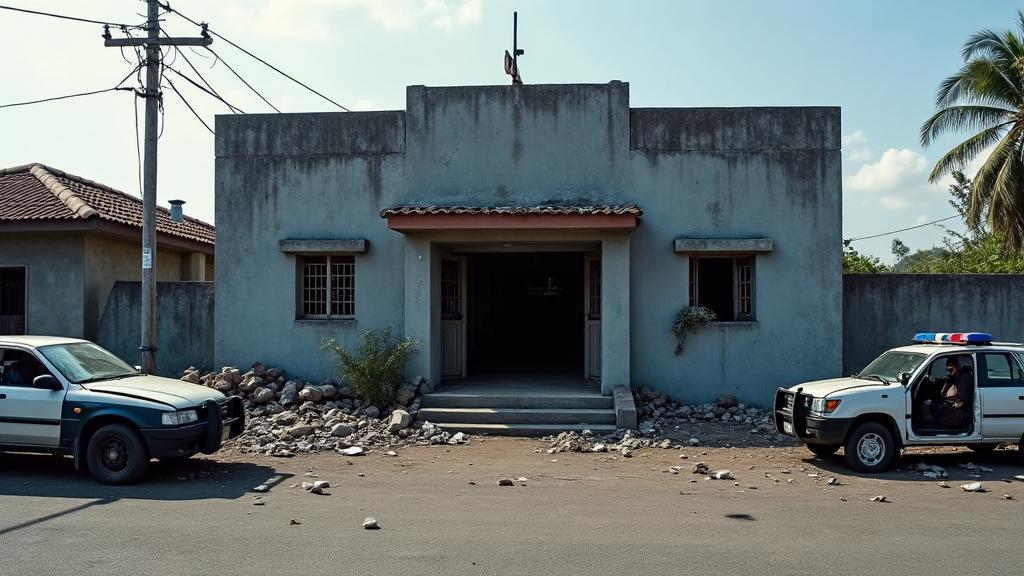
Cúcuta's Secretaría de Seguridad Ciudadana, Policía Nacional and Migración Colombia launched the first migratory identification and deportation operation since Abelardo de la Espriella became Colombia's president.
Ten foreigners in irregular status detected in Cúcuta have been expelled, including one with an active homicide warrant in Venezuela.
Operations involve street, park and commercial-establishment document checks and background verification.
Security Secretary Edwin Cardona said the measures are not aimed at Venezuelans generally but at criminals.
Source ecology
Efecto Cocuyo · independent ve · reliability B
Independent, human rights focused — Independent digital media (Luz Mely Reyes, director)
- Smaller team limits coverage breadth
This report from Efecto Cocuyo describes the first migratory identification and deportation operation in Cúcuta since Abelardo de la Espriella assumed Colombia's presidency. According to the article, the Secretaría de Seguridad Ciudadana de Cúcuta, the Policía Nacional and Migración Colombia conducted document checks in streets, parks and commercial establishments, and expelled ten foreigners in irregular status, including one individual with an active homicide warrant in Venezuela. The signal is therefore a border-enforcement development with a bilateral security dimension: a routine-sounding municipal operation that nonetheless carries a cross-border criminal-justice element. The source is an independent Venezuelan digital outlet with a human-rights focus and a B reliability rating; its profile suggests the account is likely to foreground the treatment of migrants and the rights implications of such operations, and its smaller team may limit how broadly it can verify operational details. The article's own evidence count is zero for each claim, meaning our corpus has no matching record for these specific assertions; we cannot yet check them against other sources. That is a limit of our check, not a finding that the events are uncorroborated in the world.
The epistemic status of the three claims is asserted rather than independently verified within the material provided. The first claim is a political-context claim: it ties the operation to a change in Colombia's presidency, which, if accurate, would mark a shift in enforcement posture at the Cúcuta crossing. The second is a concrete outcome claim: ten expulsions, one with an active homicide warrant in Venezuela. The third is a method claim: street, park and commercial document checks with background verification. These are the kinds of operational facts that are typically confirmed through official press releases or statistics, not through a single independent outlet. Because our per-claim corroboration probe cannot yet tell whether two sources report the same claim, we cannot say whether these assertions are echoed elsewhere; we can only note that our corpus has no matching record for them. The source's independence and human-rights orientation make it a plausible but not neutral narrator of enforcement actions, and its limited coverage breadth means it may not capture the full scope of operations.
What would change this assessment is observable and specific. If Cúcuta authorities report additional mass migratory operations or expulsions beyond the initial ten cases within about 30 days, that would indicate a sustained rather than one-off enforcement pattern. If Migración Colombia publishes data showing a sustained increase in Venezuelan regularization applications at Cúcuta service points within about 60 days, that would suggest a behavioral response by migrants that could either reflect deterrence or a rush to regularize. Conversely, the absence of such official data would leave the initial account standing as a single-source assertion. The presence of a homicide warrant in the reported expulsions, if confirmed, would also raise the question of whether this was a targeted criminal case rather than a broad migration sweep. Until such corroboration or official data appears, the appropriate reading is that this is a notable but unverified signal from an independent Venezuelan outlet, and our own inability to cross-check it should not be mistaken for a judgment about its truth.
The claims, made testable
- asserted — check unavailable Cúcuta's Secretaría de Seguridad Ciudadana, Policía Nacional and Migración Colombia launched the first migratory identification and deportation operation since Abelardo de la Espriella became Colombia's president. (evidence: not measured)
- asserted — check unavailable Ten foreigners in irregular status detected in Cúcuta have been expelled, including one with an active homicide warrant in Venezuela. (evidence: not measured)
- asserted — check unavailable Operations involve street, park and commercial-establishment document checks and background verification. (evidence: not measured)
Pattern: 302 related Venezuela signals in the last 30 days on migration, colombia-venezuela border, deportations.
What would change the assessment
- Cúcuta authorities report additional mass migratory operations or expulsions beyond the initial ten cases (within 30 days — Migración Colombia press releases / Efecto Cocuyo wires)
- Migración Colombia publishes data showing a sustained increase in Venezuelan regularization applications at Cúcuta service points (within 60 days — Migración Colombia statistics portal)
Grounded analysis — deterministic intelligence + AI synthesis anchored to real signals (deterministic + anchored deepseek-chat). No fact is asserted that the sources do not support.
What the sources establish
The source makes the assertions summarized above; VeraVadis has not yet found independent corroboration in its corpus.
Actors named in sources
Abelardo de la Espriella · Edwin Cardona · Cúcuta · Migración Colombia · Policía Nacional de Colombia · Secretaría de Seguridad Ciudadana de Cúcuta · Alcaldía de Cúcuta
Click an actor to see other briefs that name it.
What's still unverified
- Everything above is one outlet's account; none of it has been independently corroborated yet.
2 pieces · 2 outlets · 1 independent voices (one root per outlet; an upper bound)
- Sep 16, 2026 La Opinión Cúcuta · not profiled — Cúcuta extiende los operativos de control a migrantes
- Sep 16, 2026 Efecto Cocuyo · independent voice B — Colombia inicia operativos para identificar y devolver migrantes en situación irregular (this piece)
Membership by shared distinctive terms within ±3 days, ≥3 terms · sealed snapshot ab0b8b9ef0ff
AI-assisted synthesis anchored to a real VeraVadis-analyzed source. Cleared by VeraVadis's automated editorial gates on 2026-09-16 — not reviewed by a human editor. Archive piece: published under our earlier method. It does not carry the per-claim evidence chain — who reported it first and who is echoing whom — that our current pieces carry. The source link and the date are the original ones.